Khaled Mardam-Bey, mIRC developer
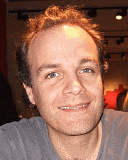
I'm Khaled Mardam-Bey, the developer of mIRC.
I started working on mIRC in 1994 while studying for a
Cognitive Science
degree at the University of Westminster in London, where I first learned
about the Internet.
I had just discovered IRC,
which at the time was accessed mainly through text-only,
shell-based IRC clients like
ircII,
and found myself thinking: if only it was a little more intuitive, more
people might use it. I wondered if I could create an IRC client that made
IRC more fun and accessible, while retaining the technical aspects
that many people enjoyed, and set to work on what I thought would be a
small project.
After releasing the first version of mIRC publicly to see if anyone
liked it, its popularity grew dramatically and for the next decade I found
myself at the receiving end of thousands of emails from people all over
the world asking for more features. What had started out as a small idea
and a personal hobby became an all-consuming, never-ending project and
full-time job.
Today, mIRC and IRC are used by many inviduals and organizations for
real-time communication in a wide variety of contexts.
Where can I learn more?
If you have a question about mIRC or IRC, or about me, or need help
with a project or homework, please read through my personal FAQ
which answers these questions and many more.
If you have a feature suggestion or a bug report, please post
it on the Discussion Forums.
You can email it to me directly, however posting it on the discussion
forums is often more helpful.
If you need help with registering mIRC, see the registration section
in my personal FAQ.
If you need to contact me, you can find my email address in the email section in my
personal FAQ.
|
